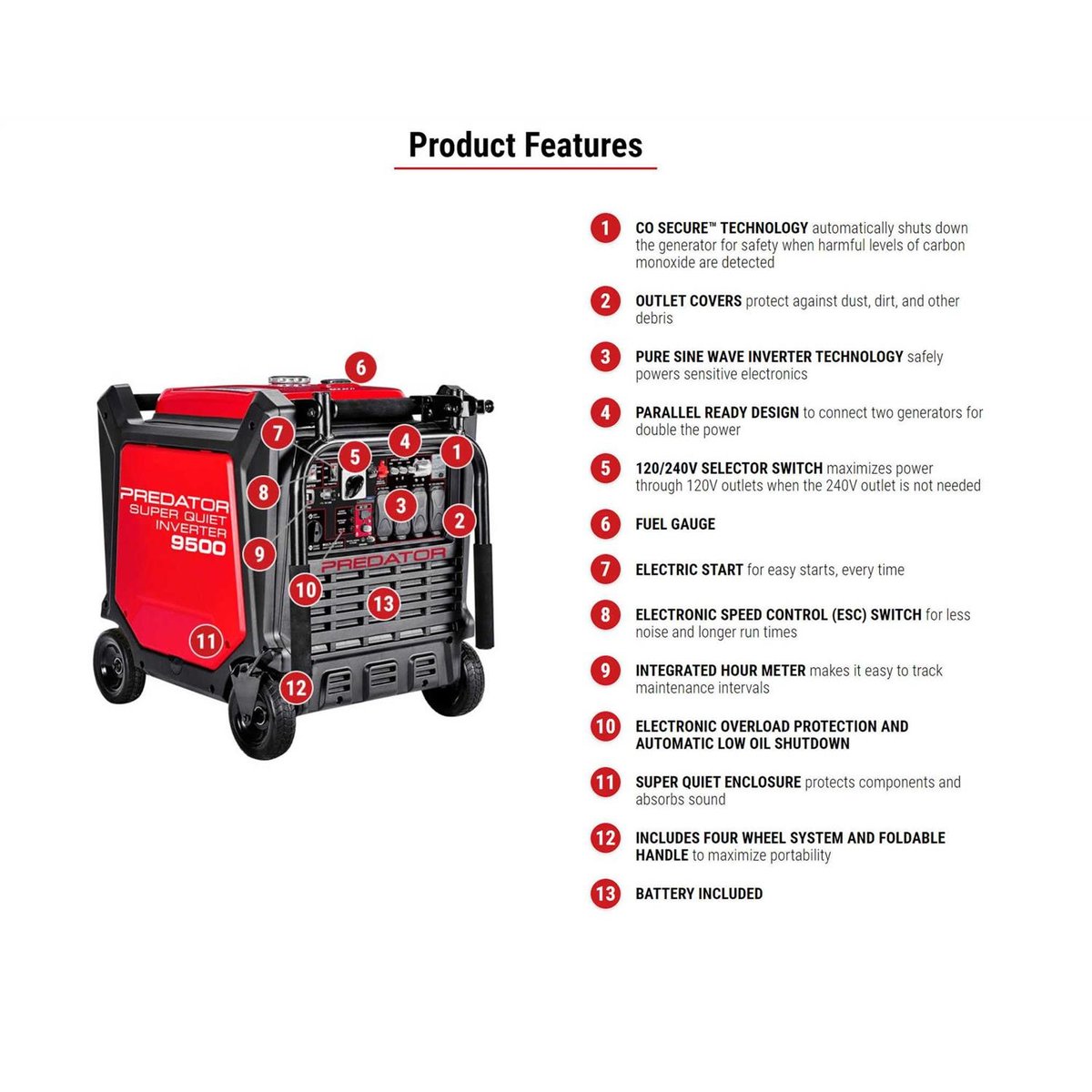
So, you've invested in a Predator 9500 Inverter Generator. Smart choice. This machine isn't just another portable power source; it's a testament to powerful, clean energy packed into a surprisingly affordable and user-friendly design. But like any high-performance equipment, getting your Predator 9500 Generator Setup & First Use dialed in correctly is crucial. Mishandling these initial steps can lead to frustration, reduced lifespan, or even safety hazards. We're here to guide you through every critical step, ensuring your generator is ready to deliver reliable power when you need it most.
Whether you're preparing for a power outage, heading to a remote job site, or powering your RV adventures, knowing the ins and outs of your Predator 9500 from the get-go will make all the difference. This guide will transform you from a new owner into a confident operator, ready to harness its full potential.
At a Glance: Key Takeaways for Your Predator 9500
- Read the Manual (Seriously!): While this guide is comprehensive, your specific manual has crucial safety warnings and diagrams unique to your unit.
- Initial Setup is Key: Don't skip steps like adding oil, connecting the battery, and proper grounding. These are non-negotiable for safe and effective operation.
- Fuel Matters: Always use fresh, unleaded gasoline with an octane of 87 or higher. Stale fuel is a common cause of starting issues.
- Safety First, Always: Operate outdoors in well-ventilated areas, away from windows and doors, to prevent carbon monoxide poisoning.
- Break-in Period: Your generator might need 15-20 hours of gentle use before truly settling in. Don't push it to max load immediately.
- Clean Power: This is an inverter generator, meaning it produces electricity safe for all your sensitive electronics.
- Maintenance Extends Life: Regular checks and scheduled maintenance are vital for longevity and performance.
Why the Predator 9500 Stands Out: A Quick Look
The Predator 9500 Inverter Generator has carved out a unique niche in the market, bridging the gap between professional-grade performance and consumer affordability. It’s not just about raw power; it’s about how that power is delivered. Unlike many conventional open-frame generators, the 9500 utilizes advanced inverter technology, offering a suite of benefits that make it an exceptional value.
You're getting clean, stable power with less than 3% total harmonic distortion (THD), making it perfectly safe for everything from your smartphone to medical equipment. This unit is also remarkably efficient, thanks to a variable-speed engine that sips fuel according to demand, delivering up to 18.5 hours of runtime at 25% load from its 6.6-gallon tank. Plus, its operation is significantly quieter than most traditional generators, typically humming at just 67 dB at 25% load. Encased in a durable, weather-resistant enclosure with a heavy-duty steel frame, large wheels, and folding handles, it’s built for both power and portability, despite its robust 265-pound weight.
Understanding Your Powerhouse: Predator 9500 Specs at a Glance
Before we dive into the nitty-gritty of setup, let's briefly recap what this powerhouse brings to the table. Knowing these numbers helps you understand its capabilities and plan your power needs effectively.
- Starting Watts: 9500W (peak power for starting motor-driven appliances)
- Running Watts: 7600W (continuous power)
- Engine: 459cc OHV 4-stroke gas engine
- Fuel Tank: 6.6 gallons
- Runtime: Up to 18.5 hours at 25% load
- Noise Level: 67 dB at 25% load (much quieter than conventional generators)
- Weight: 265 pounds (a solid build, but plan for two people to move it)
- Dimensions: 28.5" L x 27.5" W x 28.5" H
- Outlets: A versatile array including four 120V 20A GFCI, one 120V/240V 30A twist-lock (L14-30R), one 120V/240V 50A (14-50R), and two USB ports.
- Key Features: Electric start, backup recoil start, CO SECURE Technology, automatic low oil shutdown, parallel capability.
This combination of features and power output makes the Predator 9500 a true workhorse, ready for demanding tasks.
Real-World Power: What Can Your 9500 Run?
With 7600 running watts and a 9500W starting surge, your Predator 9500 is capable of powering a wide array of equipment, making it incredibly versatile. Let's look at some practical examples to put its capacity into perspective:
- Home Backup: You can comfortably run essential home systems simultaneously. Think a refrigerator (700W), freezer (500W), furnace fan (800W), sump pump (1200W starting/800W running), multiple lights (400-800W), microwave (1000W), TV/internet (200W), and even a window air conditioner or portable heater (1500W). This unit can keep your family comfortable during an extended outage.
- Construction & Job Sites: Power multiple heavy-duty tools without breaking a sweat. It can handle air compressors (2200W starting/1500W running), circular saws (1800W), table saws (2000W starting/1800W running), battery chargers (200-400W), work lights (600W), and even concrete mixers (2000W starting/1000W running).
- RV & Camping: For larger RVs, this generator is a game-changer. It can easily power a 15,000 BTU RV air conditioner (3300W starting/1500W running), an electric water heater (1500W), induction cooktops (1800W), microwave (1000W), and all your interior lighting, entertainment, and small appliances.
- Special Events & Mobile Businesses: If you're running a food truck, an outdoor event, or a mobile workshop, the 9500 can support commercial refrigeration (1000W), cooking equipment (2000-3000W), PA systems (500W), and lighting setups.
The key is understanding the starting and running wattage of your appliances to avoid overloading the generator. Generally, try to leave a buffer to account for simultaneous starting loads. For a more detailed breakdown of capabilities, consider diving deeper into Your complete Predator Generator 9500 guide.
Unboxing & First Steps: Getting Your Generator Ready
The excitement of unboxing your new Predator 9500 is palpable, but resist the urge to just fire it up. A few crucial steps are required to ensure its longevity and your safety.
- Unbox and Inspect:
- Carefully remove the generator from its packaging.
- Inspect for any shipping damage (dents, cracks, leaks). If you find any, contact Harbor Freight immediately.
- Verify all components listed in the manual are present (e.g., spark plug wrench, oil funnel, battery charger).
- Add Engine Oil – Critical Step!
- Your generator ships WITHOUT oil. Attempting to start it dry will cause severe engine damage.
- Locate the oil fill cap/dipstick.
- Using the provided funnel, add approximately 37.2 oz (just over 1 quart) of 10W-30 engine oil. Check your manual for specific oil type recommendations based on your climate.
- Fill slowly, checking the dipstick frequently. Do not overfill; the oil level should be at the upper mark on the dipstick when the generator is on a level surface.
- Securely replace the oil cap.
- Fuel Up with Fresh Gasoline:
- Only use fresh, unleaded gasoline with an octane rating of 87 or higher. E10 (up to 10% ethanol) is generally acceptable, but avoid E15 or E85, as higher ethanol content can damage small engines.
- Ensure the generator is turned off and cool before adding fuel.
- Fill the 6.6-gallon fuel tank. Leave a little room at the top for expansion – don't fill to the very brim.
- Securely replace the fuel cap.
- Connect the Battery:
- The Predator 9500 features electric start, powered by a built-in battery. This battery is usually disconnected for shipping.
- Locate the battery compartment (refer to your manual for its exact position, often near the control panel).
- Connect the positive (+) battery cable (red) to the positive (+) battery terminal.
- Connect the negative (-) battery cable (black) to the negative (-) battery terminal.
- Ensure connections are tight. The generator includes a built-in trickle charger, so once running, it will maintain the battery.
- Properly Ground the Generator:
- This is a critical safety step to prevent electrical shock.
- Locate the grounding terminal on the generator frame.
- Connect a heavy-duty grounding wire (e.g., 8-gauge copper wire) from the generator's grounding terminal to a known ground source. This could be a metal grounding rod driven at least 8 feet into the earth, or to the grounding system of your building (if using a transfer switch).
- Always consult local electrical codes and a qualified electrician for specific grounding requirements, especially for home backup scenarios.
Ignition Protocol: Starting Your Predator 9500
Once your generator is prepped, it's time to bring it to life. Remember, safety first – always operate your generator outdoors, far from windows, doors, and vents, to prevent carbon monoxide buildup.
Step 1: Safety and Placement Check
- Location: Place the generator on a firm, level surface in a well-ventilated outdoor area. Ensure at least 5 feet of clearance on all sides.
- CO SECURE: Your generator is equipped with CO SECURE Technology, which automatically shuts down the engine if hazardous levels of carbon monoxide are detected. This is a vital safety feature, but it's no substitute for proper placement.
- Pre-Flight Check: Double-check oil and fuel levels. Make sure all connected appliances are turned off or unplugged from the generator outlets until it's running smoothly.
Step 2: Electric Start Procedure
The electric start is the primary and most convenient way to get your 9500 running.
- Turn the Main Dial: Rotate the main control dial (often a large rotary switch) to the "CHOKE" position. This enriches the fuel mixture for cold starts.
- Press Start: Push and hold the electric start button for 2-3 seconds. The engine should crank and typically start within a few attempts. Avoid holding the button down for too long to prevent overheating the starter motor. If it doesn't start, release, wait a few seconds, and try again.
- Warm Up & Run: Once the engine starts, gradually turn the main dial from "CHOKE" to the "RUN" position as the engine warms up (usually within 30-60 seconds). If you switch too quickly, the engine might stall.
- Engage ECO Mode (Optional): For lighter loads or when no loads are connected, you can turn the dial to "ECO" mode. This allows the engine speed to adjust dynamically to the power demand, saving fuel and reducing noise. Disable ECO mode for large motor-driven appliances or when power demands fluctuate significantly.
Step 3: Manual Start (Backup Recoil Start)
If your battery is dead or the electric start isn't working for any reason, the recoil start is your reliable backup.
- Follow Steps 1-3 from Electric Start: Ensure the generator is prepped, placed safely, and the main dial is set to "CHOKE."
- Prepare for Pull: Grasp the recoil starter handle firmly.
- Pull Smoothly: Pull the handle slowly until you feel resistance. This indicates the piston is at the top of its compression stroke.
- Pull Quickly: With a quick, strong, fluid motion, pull the handle all the way out. Do not let the handle snap back; guide it gently.
- Repeat if Necessary: It might take a few pulls to start the engine, especially if it's cold.
- Warm Up & Run: Once the engine starts, gradually turn the main dial from "CHOKE" to "RUN." You can then engage "ECO" mode if desired.
Smart Operation for Peak Performance & Longevity
Starting your generator is just the beginning. Operating it intelligently will maximize its efficiency, extend its lifespan, and ensure you're getting the most out of your investment.
- Apply Loads Gradually: Never plug in all your appliances at once, especially large ones. Start the generator, let it stabilize, then connect your largest devices first. Wait a minute, then add smaller loads. This prevents surge overloads.
- Master ECO Mode:
- Use it for: Smaller, stable loads like lights, charging devices, or when no power is being drawn. It significantly saves fuel and reduces noise.
- Disable it for: Appliances with motors (refrigerators, pumps, power tools) that have high starting loads, or when you need constant, full power without fluctuations. ECO mode can sometimes cause "surging" or difficulty starting high-demand appliances.
- Balance 240V Loads: If you're utilizing the 120V/240V outlets, try to balance the load across both 120V legs if possible. This ensures optimal performance and prevents uneven strain on the generator. Consult an electrician if wiring into a home transfer switch.
- Plan for Shutdowns & Refueling: Generators aren't meant to run indefinitely. Plan for cool-down periods every 8-12 hours.
- Always turn off the generator and allow it to cool for at least 15 minutes before adding fuel. Hot fuel is a fire hazard.
- Perform quick checks (oil level, visual inspection) during these breaks.
- Use Appropriate Extension Cords: For long runs or heavy loads, use heavy-duty 10-gauge or 12-gauge outdoor-rated extension cords. Undersized cords can lead to voltage drop, overheating, and potential damage to both the cord and your appliances. Never use frayed or damaged cords.
- Monitor the Control Panel: Your digital control panel offers wattage output, runtime, and maintenance tracking. Keep an eye on it to prevent overloading and anticipate service needs.
Keeping It Running: Essential Maintenance Schedules
Consistent maintenance is the single best way to ensure your Predator 9500 remains a reliable workhorse for years to come. Refer to your owner's manual for the most precise schedule and instructions, but here’s a general overview:
Before Each Use
- Engine Oil Level: Check the dipstick. Top off if low.
- Air Filter: Inspect for excessive dirt or debris. Clean if needed.
- Fuel Level/Condition: Ensure you have enough fresh, quality fuel.
- Covers/Guards: Verify all covers and guards are secure.
- Cooling Air Inlets: Ensure they are clear of obstructions.
Initial Break-in Service (After First 20 Hours)
- Change Engine Oil: The initial oil change is crucial to remove any manufacturing debris from the engine.
- Check/Adjust Valve Clearance: This is a more advanced task; consult your manual or a service professional.
- Inspect/Clean Spark Arrestor: Prevents sparks from escaping the exhaust.
Every 50 Hours / 3 Months (or more frequently in dusty conditions)
- Clean Air Filter: A clean air filter is vital for engine performance and fuel efficiency.
- Change Oil: If operating in dirty environments or under heavy load.
Every 100 Hours / 6 Months
- Change Engine Oil: Standard interval for most operating conditions.
- Clean/Replace Air Filter: Based on inspection, replace the paper element if heavily soiled.
- Inspect/Clean Spark Plug: Check for fouling and proper gap. Replace if worn.
- Clean Fuel Sediment Cup: Removes impurities from the fuel system.
- Check/Clean Spark Arrestor.
- Check/Adjust Valve Clearance: Again, consider professional help for this.
Every 300 Hours / Annually
- Replace Spark Plug: Standard annual replacement.
- Replace Air Filter.
- Clean Fuel Tank/Filter: More thorough fuel system maintenance.
- Check All Fuel Lines/Connections: Inspect for cracks, leaks, or damage.
- Inspect/Clean Cooling Fins: Ensures proper engine cooling.
Quick Maintenance How-Tos:
- Oil Change: Warm the engine for a few minutes, then turn it off. Place a drain pan underneath, remove the drain plug, and allow the oil to drain completely. Replace the plug and refill with approximately 37.2 oz of 10W-30 oil, checking the dipstick.
- Air Filter: The foam element can usually be washed with soapy water, dried, and lightly oiled. The paper element should be tapped clean or replaced if heavily soiled.
- Battery Care: For storage over 30 days, disconnect the battery or use a trickle charger to maintain its charge. When replacing, disconnect the negative (-) terminal first, then the positive (+). Connect the new battery positive (+) first, then negative (-). Use an equivalent 12V sealed lead-acid battery.
Preparing for the Long Haul: Generator Storage
If you're storing your Predator 9500 for over 30 days, proper preparation is essential to prevent issues down the line.
- Fuel Stabilization: Add a fuel stabilizer to the gas tank and run the generator for about 10 minutes to circulate the treated fuel through the carburetor.
- Run Dry: Turn off the fuel valve (if equipped) or disconnect the fuel line and allow the generator to run until it stalls. This empties the carburetor bowl, preventing gumming.
- Oil Change: Perform an oil change to ensure fresh, clean oil is present for storage.
- Cylinder Preservation: Remove the spark plug, pour about one tablespoon of engine oil into the cylinder, and slowly pull the starter rope a few times to distribute the oil. Reinstall the spark plug. This prevents corrosion.
- Clean Exterior: Wipe down the generator to remove dirt and grime.
- Battery Disconnection: Disconnect the battery or connect it to a trickle charger to prevent discharge.
- Cover: Use a breathable generator cover to protect it from dust and moisture.
- Storage Location: Store the generator in a clean, dry, well-ventilated area, away from direct sunlight and extreme temperatures.
When Things Go Sideways: Troubleshooting Common Issues
Even with the best preparation, generators can sometimes be finicky. Here are some common issues and their potential solutions:
- Generator Won't Start:
- No Fuel/Stale Fuel: Check the fuel tank. Ensure the fuel is fresh (gasoline degrades over time, especially with ethanol).
- Low Oil: The low oil shutdown system is a safety feature; check and fill the oil.
- Spark Plug Issues: Inspect the spark plug for fouling (carbon buildup) or damage. Clean or replace as needed.
- Clogged Air Filter: A dirty air filter restricts airflow, making starting difficult. Clean or replace.
- Choke Position: Ensure the choke is set correctly for a cold start, then moved to RUN.
- Battery Charge (Electric Start): For electric start, check the battery charge and connections. If it's old (typical lifespan 2-3 years), it might need replacement.
- Power Output Problems:
- No Power: Check the generator's circuit breakers and GFCI outlets (reset them). Ensure you're not overloading the unit.
- Reduced Power/Surging: This can be due to an overloaded circuit, old fuel, a dirty air filter, or an issue with the governor. If using ECO mode with variable or high loads, try disabling it.
- Altitude Effects: Generators lose approximately 3.5% of their power for every 1,000 feet above sea level. This is normal, not a fault.
- Engine Performance Issues:
- Runs Rough/Surges: Often points to poor fuel quality, a partially clogged carburetor, or a restricted air filter. If in ECO mode, try disabling it.
- Excessive Fuel Consumption: Running with ECO mode disabled at full throttle when not needed, a dirty air filter, or carburetor issues can increase fuel consumption.
- Noise/Vibration:
- Excessive Noise: Ensure ECO mode is engaged when appropriate. Check for loose components or issues with the exhaust system.
- Abnormal Vibration: Ensure the generator is on a level, stable surface. Check for loose engine mounts or other components.
Always consult your Predator 9500 owner's manual for detailed troubleshooting guides specific to your model. If issues persist, Harbor Freight stores offer assistance and warranty service.
The Predator 9500's True Value: Beyond the Price Tag
While the initial purchase price of $1,899 - $2,199 is already compelling, the Predator 9500's value extends far beyond that. It often costs significantly less than comparable premium Japanese inverter generators (which can range from $4,000-$7,000) and even other domestic models ($2,500-$3,500).
You're not sacrificing performance either. The Predator 9500 delivers clean power (<3% THD) and stable output (voltage/frequency within ±3%) that rivals its more expensive counterparts. Its fuel efficiency, at roughly 0.55 gallons/hour at 25% load, translates into significant long-term savings. Furthermore, its widespread availability through Harbor Freight simplifies access to warranty service, parts, and accessories, and replacement parts are generally 30-50% less expensive than premium brands.
However, it's also fair to acknowledge some common criticisms:
- Weight: At 265 pounds, it's a beast. While robust, it usually requires two people or a ramp to load/unload.
- Oil Changes: The design can make oil changes a bit messier than some other units.
- Initial Break-in: Some users report a slightly longer break-in period (15-20 hours) for optimal smoothness.
- Manual Clarity: While comprehensive, some instructions could be clearer or more detailed.
- Wheel Durability: The stock wheels are fine for improved surfaces, but serious off-road use might benefit from an aftermarket pneumatic wheel upgrade.
These are minor points when weighed against its overall performance and affordability.
Maximizing Your Investment: Recommended Accessories & Upgrades
To truly make your Predator 9500 an indispensable part of your power strategy, consider these accessories:
Essential Add-ons:
- Predator 9500 Generator Cover: Protects your investment from weather and dust when not in use.
- Heavy-Duty Extension Cords: Invest in high-quality 10-gauge or 12-gauge outdoor-rated cords for long runs or heavy loads.
- Transfer Switch Kit: If you plan to use it for home backup, a professionally installed manual transfer switch is essential for safely connecting your generator to your home's electrical panel. Never backfeed power into your home's wiring.
- Maintenance Kit: Often includes a spark plug, air filter, and oil filter (if applicable).
- Oil Funnel & Drain Pan: For cleaner oil changes.
Valuable Enhancements:
- Wheel Upgrade Kit: If you'll be moving your heavy generator over rough terrain, aftermarket pneumatic wheels offer a significant improvement over the stock solid wheels.
- Extended Run Fuel System: For truly long runtimes without interruption, an external fuel tank connection can be invaluable.
- Parallel Kit: If you ever need even more power, you can link two compatible Predator inverter generators together.
- Hour Meter/Tachometer: While the digital panel tracks hours, a dedicated meter can provide additional data.
- Weather Shields: Can offer extra protection to the control panel during inclement weather.
Is the Predator 9500 Right for You? Ideal vs. Less Suitable Use Cases
The Predator 9500 is a fantastic generator for many, but not every scenario. Here’s a quick guide to help you decide:
Ideal Use Cases:
- Homeowners: Needing substantial emergency backup power for multiple essential home systems.
- RV Owners: Requiring significant capacity for air conditioning and other amenities in larger motorhomes or fifth wheels.
- Contractors & Construction Professionals: Needing clean power for sensitive electronics alongside traditional power tools on job sites.
- Mobile Businesses & Event Professionals: Requiring substantial, relatively quiet power for commercial operations.
- Value-Conscious Buyers: Seeking premium inverter features and ample power without the premium price tag.
Less Suitable For:
- Ultra-Lightweight Applications: If minimum weight and extreme portability are your primary concerns, 265 pounds is substantial.
- Absolute Minimum Noise Levels: While quiet for its class, if you need near-silent operation regardless of cost, premium smaller inverter generators might be quieter at very light loads.
- Maximum Warranty Length: While 2 years residential is solid, some premium brands offer longer terms (though at a much higher price).
- Power Requirements Exceeding 7600 Running Watts: This unit has a generous capacity, but if your continuous load exceeds 7600W, you'll need to parallel two units or opt for a larger, possibly conventional, generator.
Powering Forward with Confidence
Your Predator 9500 is a powerful, reliable, and intelligent investment. By following these setup steps, understanding its capabilities, and committing to proper maintenance, you're not just buying a generator – you're securing a dependable source of power for years to come. Treat it well, and it will serve you exceptionally. Now go forth, and power your world with confidence!